UAE E-Invoicing: Who Is in Scope, the 2027 Deadlines, and What Happens If You Miss Them
Updated September 2026. Based on the Ministry of Finance UAE Electronic Invoicing Guidelines V1.1 (1 June 2026), Ministerial Decisions No. 243 and 244 of 2025 (as amended in May 2026), and Cabinet Decision No. 106 of 2025.
There is a date in the UAE e-invoicing rollout that most businesses have not registered, and it is not the one in the headlines.
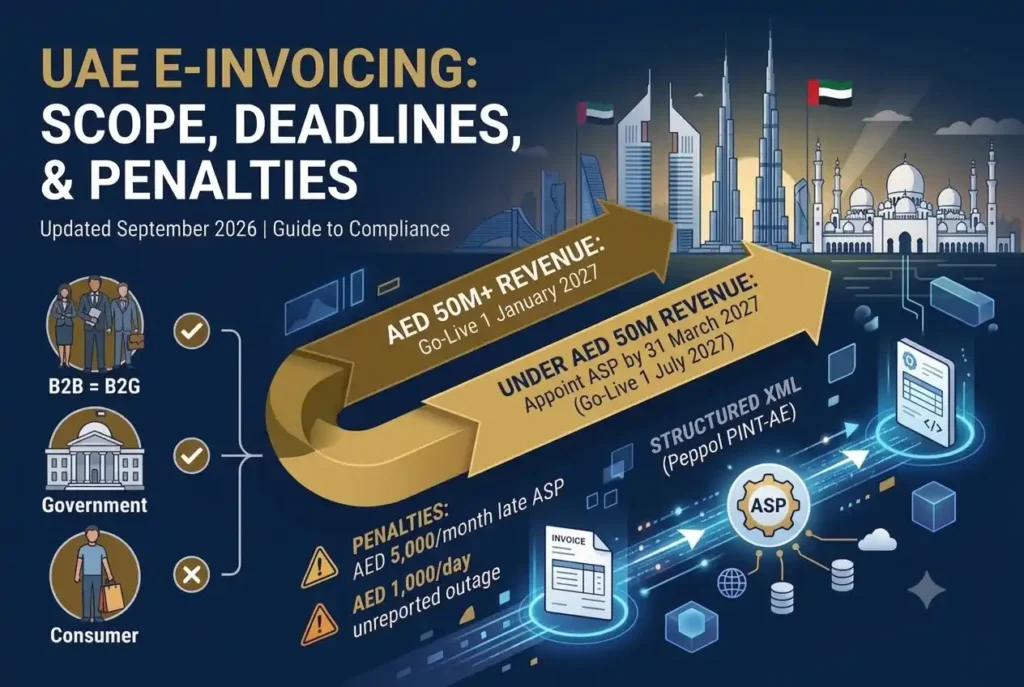
If your annual revenue is under AED 50 million, you have read that e-invoicing becomes mandatory for you on 1 July 2027. That is correct. But it is not your deadline. Your deadline is 31 March 2027 — the date by which you must have appointed an Accredited Service Provider. Go-live comes three months later, and you cannot go live without a provider already in place.
Businesses above AED 50 million have until 30 October 2026 — the Ministry extended that deadline from 31 July, but go-live still lands on 1 January 2027. The extension bought preparation time, not a delay.
This guide covers who is caught, what is excluded, what the deadlines actually require, what non-compliance costs, and the question we are asked more than any other: whether your existing accounting software is enough.
What UAE e-invoicing actually is
A common assumption is that e-invoicing means emailing a PDF instead of posting paper. It does not.
Under the UAE system, an electronic invoice is a structured XML file, issued in the Peppol PINT-AE format, transmitted through an Accredited Service Provider, and reported to the Federal Tax Authority in near real time. A PDF is not an electronic invoice. Neither is a Word document, a spreadsheet, or a scanned image.
Two details surprise people who have followed the Saudi rollout:
- There is no QR code. UAE e-invoices carry no QR code and no barcode. Each one instead carries a system-generated UUID that uniquely identifies it, alongside your normal sequential invoice number.
- The e-invoice is your tax invoice. Under Article 65(5) of the VAT Decree-Law, a business in scope must issue its tax invoice in the form of an electronic invoice. It is not an additional document you file alongside the old one.
One practical consequence during the transition: where your buyer is not yet live on the system, they may still ask you for a readable PDF so they can recover input VAT and support their corporate tax deduction. That PDF is a courtesy copy, not the legal invoice.
Who is in scope — and the misconception that catches most businesses
Electronic invoicing is mandatory for any person conducting business in the UAE, in respect of every business transaction, regardless of VAT registration status.
That sentence, drawn from the Ministry’s own guidelines, is the one that catches people out. The scope is not defined by whether you are registered for VAT. It is defined by whether you are conducting business.
Here is what falls in and out by counterparty:
| You are selling to | In scope? |
|---|---|
| Another business (B2B) | Yes |
| A government entity (B2G) | Yes |
| A consumer (B2C) | No |
Sales to private individuals who are not in business sit outside the system. Everything else you invoice does not.
If you are not registered for VAT
You are still in scope. Registration status is irrelevant to the e-invoicing obligation.
There is a further step for this group. Your participant identifier on the network is built from your Tax Identification Number, which is the first ten digits of your TRN. If you have never registered with the FTA for any tax type, you do not have a TIN — so you must register with the FTA to obtain one before you can be onboarded at all.
If you are a free zone company
Free zone entities are in scope. There is no free zone carve-out from e-invoicing, and a 0% corporate tax position has no bearing on it. Certain free zone supplies in fact require additional beneficiary details on the invoice beyond the standard field set.
If you are a holding company
A purely passive holding company earning only investment income has no business transactions and stays outside. The moment it recharges management costs, office costs or any other expense to a group company or third party, those recharges are business transactions — and the company must onboard and issue electronic invoices for them.
If you are part of a tax group
Transactions between members of the same VAT group are within scope, but the Ministry has granted a 24-month grace period running from 1 January 2027. In practice, intra-group e-invoicing begins on 1 January 2029.
Watch this one
The grace period covers intra-group transactions only. Everything your group entities invoice to outside parties follows the normal timeline. And each legal entity onboards separately — a group of ten companies makes ten ASP appointments, even inside a single VAT group. Note also that your participant identifier uses your own TRN, not the group representative’s.
What is excluded
The exclusions are narrow:
- Government entities acting in a sovereign capacity, where not competing with the private sector
- International passenger transport by airlines where an electronic ticket is issued, and ancillary passenger services documented by an Electronic Miscellaneous Document
- Financial services exempt from VAT under Article 42 of the VAT Executive Regulation, and those exempt services where they qualify as zero-rated exports
- International transport of goods by airlines under an Airway Bill — temporarily, for 24 months only
Not an exclusion
Exempt supplies and out-of-scope supplies still require an electronic invoice. Being outside the VAT net does not put a transaction outside the e-invoicing net. And administrative exceptions the FTA granted you for tax invoices do not carry over to electronic invoices — those need to be revisited.
The deadlines
| Who you are | Appoint an ASP by | Go live by |
|---|---|---|
| Revenue AED 50m or more | 30 October 2026 | 1 January 2027 |
| Revenue under AED 50m | 31 March 2027 | 1 July 2027 |
| Government entities | 31 March 2027 | 1 October 2027 |
The first of those dates moved. In May 2026 the Ministry amended Ministerial Decision No. 244 of 2025 to push the AED 50 million ASP deadline from 31 July to 30 October 2026, following feedback on provider availability and pricing. The same announcement relaxed the accreditation rules for providers, allowing white-label and outsourced models while leaving compliance responsibility with the accredited provider. Go-live for that group did not move.
Revenue means gross income for your most recent accounting period, taken from your financial statements. It includes income that is itself outside e-invoicing — consumer sales count toward the threshold even though consumer invoices are not e-invoiced.
Voluntary onboarding has been open to everyone since 1 July 2026, and there is a strong argument for using it. Penalties do not apply to businesses operating voluntarily ahead of their mandatory date. You can test, fail, fix and re-test with no financial exposure — a window that closes the moment your phase begins.
Treat the ASP appointment date as the real deadline. Selection, contracting, EmaraTax onboarding, system mapping and end-to-end testing all sit between appointing a provider and issuing your first compliant invoice. Three months is not generous.
What non-compliance costs
Cabinet Decision No. 106 of 2025 sets a dedicated penalty regime for e-invoicing. It is already law.
| Violation | Penalty |
|---|---|
| Failing to implement the system or appoint an ASP by your deadline | AED 5,000 per month |
| Electronic invoice not issued or transmitted in time | AED 100 each, capped at AED 5,000 per month |
| Electronic credit note not issued or transmitted in time | AED 100 each, capped at AED 5,000 per month |
| Failing to notify a system failure or a change in registered data | AED 1,000 per day, no cap |
Three things about this table are worth dwelling on.
A partial month counts as a full month, so being one day late costs the same AED 5,000 as being thirty days late. The two AED 5,000 caps are separate, so invoices and credit notes can each run to the cap in the same month. And the daily penalty for failing to report a system outage has no ceiling at all — you have two business days to notify, and after that it runs.
These penalties also sit on top of the ordinary VAT and tax procedure penalties, not instead of them. A transmission failure that leaves gaps in your VAT return can trigger both regimes at once.
“Isn’t my accounting software enough?”
This is the question we field most often, usually from businesses running Zoho, Tally, QuickBooks, Xero or a similar package. The honest answer is that your software is necessary but not sufficient, and the gap is bigger than most people expect.
Your accounting system produces invoice data. UAE e-invoicing requires that data to be converted into Peppol PINT-AE XML, transmitted over the Peppol network to your buyer’s provider, and reported to the FTA in parallel — with confirmations flowing back at each step. That transmission and reporting layer is what an Accredited Service Provider does, and only an accredited provider can do it.
Three points follow from that:
- An ASP appointment is mandatory, whatever software you run. There is no version of compliance where your accounting package talks to the FTA directly.
- You appoint one ASP, not two. A single provider covers both what you send and what you receive. You cannot split sales and purchases across two providers.
- You initiate onboarding, not the provider. The process starts from your own EmaraTax account on the FTA portal.
Some accounting platforms are building integrations with accredited providers, which makes the connection smoother. That is a genuine advantage, but it does not remove the appointment, the onboarding, or the obligation — which remains yours, not your provider’s.
The part that actually derails go-live
In our experience it is rarely the technology. It is master data. Missing or wrong buyer TRNs, incomplete addresses, inconsistent item descriptions, no field for the buyer’s participant identifier. Invoices fail validation and bounce, and each bounced invoice is a document not transmitted on time. Cleaning your customer master data is the single most useful thing you can do before a provider is even appointed.
How the system works in practice
The UAE has adopted a five-corner model. Once you understand the corners, the rest of the vocabulary follows:
| Corner 1 | You, the supplier |
| Corner 2 | Your accredited service provider |
| Corner 3 | Your buyer’s provider |
| Corner 4 | Your buyer |
| Corner 5 | The Federal Tax Authority |
You send invoice data to your provider. They validate it, convert it to the required XML, transmit it to your buyer’s provider, and report the tax data to the FTA in parallel. Confirmations travel back down the chain to you.
Your address on this network is your participant identifier: the prefix 0235 followed by your ten-digit TIN. Before you can invoice a buyer, you need theirs.
What you need to do
The Ministry sets out four steps. In practice we would add a fifth at the front.
|
0. Confirm your phase and your data Establish which revenue bracket you sit in, confirm you hold a TIN, and audit your customer master data for missing TRNs and addresses. |
|
1. Understand the requirements Work out what has to change in your accounting, ERP or invoicing system, and build a plan that lands before your mandatory date rather than on it. |
|
2. Select and appoint an ASP Choose an accredited provider, complete the contract, onboard through EmaraTax, and obtain your participant identifier. |
|
3. Test end to end Agree how invoice data reaches your provider, confirm your system can produce it, and test exchange and reporting all the way through. |
|
4. Go live and stay live Agree who resolves errors and monitors transmissions, then keep EmaraTax updated whenever your circumstances change. |
One further obligation runs quietly underneath all of this: electronic invoices and their supporting data must be retained for five years after the relevant tax period — longer where a dispute, audit or voluntary disclosure is in play, and seven years for real estate records. Servers may sit outside the UAE provided the records can be retrieved complete and readable whenever the FTA asks.
Five questions we are asked most
Does e-invoicing apply if I am not registered for VAT?
Yes. The obligation applies to any person conducting business in the UAE regardless of VAT registration status. If you have never registered with the FTA for any tax, you will need to register to obtain a TIN before you can be onboarded.
Is emailing a PDF invoice enough?
No. An electronic invoice is a structured XML document exchanged through accredited providers and reported to the FTA. A PDF sent by email is not an electronic invoice, though a buyer who is not yet live may still ask for one as a readable copy.
Do I need an ASP if my accounting software already issues invoices?
Yes. Only an Accredited Service Provider can transmit invoices over the network and report them to the FTA. Your software feeds the data; the provider handles exchange and reporting. You appoint one provider covering both sales and purchases.
Are free zone companies exempt?
No. Free zone entities are in scope on the same timeline as everyone else, and some free zone supplies require additional details on the invoice.
What happens if I miss my deadline?
AED 5,000 for each month, or part of a month, that you are without an ASP or an implemented system. Invoices and credit notes not transmitted on time attract AED 100 each, capped at AED 5,000 per month each. Failing to report a system outage within two business days costs AED 1,000 per day with no cap.
How Fintra Global can help
Most of the businesses we speak to fall into one of two groups. Either they have the finance function to run this themselves and want a second pair of eyes on scope, data and timing. Or they would rather the whole thing were handled and never think about it again.
If you want to run it yourself: we carry out an e-invoicing readiness review — confirming your phase and revenue bracket, checking your entity structure for the traps above, auditing your customer master data, mapping the gaps in your invoicing system, and setting out a plan against your ASP appointment date. We work with accredited service providers and will help you select and onboard with one that suits your systems.
If you would rather outsource it: our accounting and e-invoicing package covers your bookkeeping, raises your invoices in a compliant format, and submits them through an accredited provider to the FTA on an ongoing basis, with your VAT and corporate tax filings handled on the same set of books. Pricing is tiered by invoice volume, so a business issuing thirty invoices a month is not paying for a system built for three hundred.
Either way, the useful thing to do before March is find out where you actually stand. Most businesses discover their problem is master data, not software — and that is far cheaper to fix in December than in June.
E-invoicing readiness check
Tell us your revenue bracket, your entity structure and what you invoice on. We will tell you which phase you are in, what needs to change, and what it will take to be ready. Fixed timeline, transparent pricing, CA-led.
Message us on WhatsApp Book a call Contact form
fintraglobal.com · +971 55 467 2256
This article is general guidance current as at September 2026 and is not tax advice. It reflects the Ministry of Finance UAE Electronic Invoicing Guidelines V1.1 dated 1 June 2026, which may be updated. Please seek advice on your own position.