
What is UAE E-Invoicing?
E-Invoicing is the process of creating, sending, receiving, and storing invoices in a structured electronic format rather than using paper documents or simple PDF files.
Unlike emailing a PDF invoice, E-Invoicing enables invoice data to be exchanged automatically between businesses through accredited service providers. This allows tax authorities to receive standardized transaction data while improving accuracy, reducing manual work, and enhancing business efficiency.
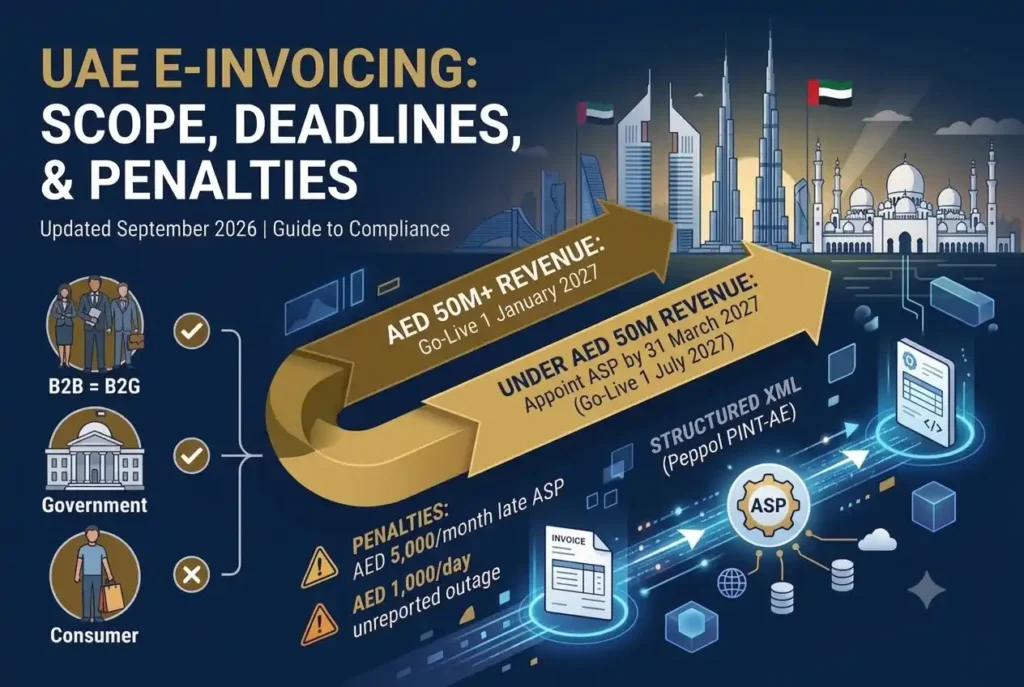
In technical terms, a UAE e-invoice is a structured XML file in the Peppol PINT AE format. It travels through a five-corner model: your system passes the invoice to your accredited provider, who validates it, transmits it to your customer’s provider, and reports the data to the Federal Tax Authority in near real time. Unlike Saudi Arabia’s system, there is no QR code requirement.
The new system is designed to create a faster, more transparent, and more reliable invoicing ecosystem across the UAE.
| PDF invoice by email | UAE e-invoice | |
|---|---|---|
| Format | PDF or Word document | Structured XML (Peppol PINT AE) |
| How it travels | Email attachment | Accredited provider network |
| Read by | A person | Software, automatically |
| Tax authority | Sees it only on audit | Receives the data in near real time |
| Counts as compliant | No | Yes |
Why is the UAE introducing E-Invoicing?
The UAE government aims to modernize its tax infrastructure and strengthen VAT compliance through digital reporting.
The objectives include:
- Reducing invoice fraud
- Improving VAT compliance
- Minimising manual data entry
- Increasing invoice processing efficiency
- Enhancing financial transparency
- Supporting the UAE’s wider digital economy initiatives
Many countries have already adopted similar systems, and the UAE is following international best practices to simplify tax administration while reducing compliance risks.
Who will be affected?
This is the point most often misunderstood, and the legislation is explicit about it.
E-Invoicing applies to any person conducting business in the UAE, for every business transaction — regardless of VAT registration status.
Earlier commentary, including the original version of this article, described the framework as applying to VAT-registered businesses. That is not correct. If you run a business in the UAE and issue invoices to other businesses, you are in scope even if your turnover has never reached the VAT registration threshold.
Free zone entities are included. Businesses with no Tax Registration Number will need to register with the Federal Tax Authority simply to obtain the identifier the system runs on.
| In scope | Outside the system |
|---|---|
| Business-to-business transactions | Sales to private consumers (B2C) |
| Business-to-government transactions | Certain exempt financial services |
| Free zone entities | International passenger transport |
| Businesses not registered for VAT | Government sovereign activities not competing with the private sector |
Exclusions are narrow and specific. If you are unsure whether a particular transaction type falls outside the system, treat it as in scope until confirmed.
UAE E-Invoicing Implementation Timeline
The Ministry of Finance has announced a phased rollout. Each phase now carries two dates: the deadline by which you must have appointed an Accredited Service Provider, and the date from which you must actually be issuing e-invoices.
| Phase | Appoint a provider by | Go live from |
|---|---|---|
| Voluntary pilot | — | 1 July 2026 |
| Revenue above AED 50 million | 30 October 2026 | 1 January 2027 |
| Revenue below AED 50 million | 31 March 2027 | 1 July 2027 |
| Government entities | 31 March 2027 | 1 October 2027 |
The date that binds
The appointment deadline is the real deadline. You cannot go live without a provider already onboarded, and onboarding is an integration project rather than a purchase. Every business in the same wave will be approaching the same small pool of accredited providers in the same quarter.
The first of these dates moved. In May 2026 the Ministry amended Ministerial Decision No. 244 of 2025 to push the AED 50 million appointment deadline from 31 July to 30 October 2026, following feedback on provider availability and pricing. The go-live date for that group did not move. The same announcement relaxed the accreditation rules for providers, permitting white-label and outsourced models while leaving compliance responsibility with the accredited provider.
Revenue is measured as gross income for your most recent accounting period. Businesses should regularly review official updates, as implementation details may continue to evolve.
What is an Accredited Service Provider, and do I need one?
Yes. Appointing an Accredited Service Provider is mandatory for every business in scope, whatever accounting software you use.
This is the question we are asked most often, usually by businesses running Zoho, Tally, QuickBooks or Xero. Your accounting software produces the invoice data. Only an accredited provider can convert that data into the required XML format, transmit it across the Peppol network, and report it to the Federal Tax Authority.
- One provider covers both your sales invoices and your purchase invoices.
- You initiate onboarding from your own EmaraTax account, not from the provider.
- Providers must hold Peppol certification and appear on the Ministry’s accredited list.
- You remain responsible for the accuracy of the data you send, even though the provider transmits it.
What actually delays businesses
In readiness work, the obstacle is rarely the technology. It is master data. Missing buyer Tax Registration Numbers, incomplete addresses, and no field to store a counterparty’s participant identifier all cause invoices to fail validation and bounce back.
Each bounced invoice is a document not transmitted on time. Cleaning customer records is slow, unglamorous work, and it is far cheaper to do it months ahead than under deadline pressure.
Penalties for non-compliance
Cabinet Decision No. 106 of 2025 sets out the penalty regime. These amounts sit on top of ordinary VAT and tax procedure penalties, not instead of them.
| Failure | Penalty |
|---|---|
| Operating without an appointed provider | AED 5,000 per month — a partial month counts as a full month |
| Invoice not transmitted in time | AED 100 per invoice, capped at AED 5,000 per month |
| Credit note not transmitted in time | AED 100 per credit note, capped at AED 5,000 per month (a separate cap) |
| System failure not reported within two business days | AED 1,000 per day, with no cap |
The uncapped daily penalty for an unreported outage is the one to watch. If your provider connection fails, you have two business days to notify the Authority. Miss that window and the charge accrues indefinitely.
Benefits of E-Invoicing
Businesses that prepare early can benefit from:
- Faster invoice processing
- Reduced manual errors
- Improved VAT compliance
- Better cash flow visibility
- Lower administrative costs
- Enhanced financial reporting
- Easier audit readiness
- Stronger data security
Over time, E-Invoicing is expected to improve operational efficiency while reducing paperwork and repetitive administrative tasks.
How should businesses prepare?
Preparation should begin well before mandatory implementation. Consider taking the following steps:
- Confirm which phase you are in. Check your gross income for the most recent accounting period against the AED 50 million threshold.
- Audit your customer and supplier data. Every business counterparty needs a valid Tax Registration Number and a complete address. This usually takes longer than expected.
- Review your existing invoicing process and identify anything still handled manually or outside your accounting system.
- Check what your accounting software can export and whether your provider of choice integrates with it. Note that software alone is not sufficient — an accredited provider is still required.
- Shortlist accredited providers early. Compare integration support and pricing before the queue forms in your phase.
- Register with the Federal Tax Authority if you do not yet hold a Tax Registration Number.
- Consult your accountant or tax advisor regarding readiness and the gap between where you are and what go-live requires.
- Stay updated with announcements from the Ministry of Finance and the Federal Tax Authority.
Early preparation will reduce disruption once compliance becomes mandatory.
Final Thoughts
E-Invoicing represents one of the biggest changes to business compliance in the UAE in recent years. While the rollout is phased, businesses that prepare now will find the transition far easier than those waiting until the final implementation dates.
Understanding the requirements, reviewing internal processes, and working with experienced tax professionals can help ensure your business remains compliant while benefiting from a more efficient invoicing system.
How Fintra Global can help
We work with UAE businesses at both ends of this.
If you want to handle it in-house, our e-invoicing readiness review confirms which phase applies to you, audits your customer and supplier data against what the format requires, reviews what your accounting system can produce, and gives you a written plan with dates.
If you would rather not deal with it at all, our accounting and e-invoicing package covers your bookkeeping, raises compliant invoices on your behalf, and submits them to the Federal Tax Authority through an accredited provider on an ongoing basis. Pricing is based on invoice volume.
Speak to us about your e-invoicing readiness: fintraglobal.com · +971 55 467 2256