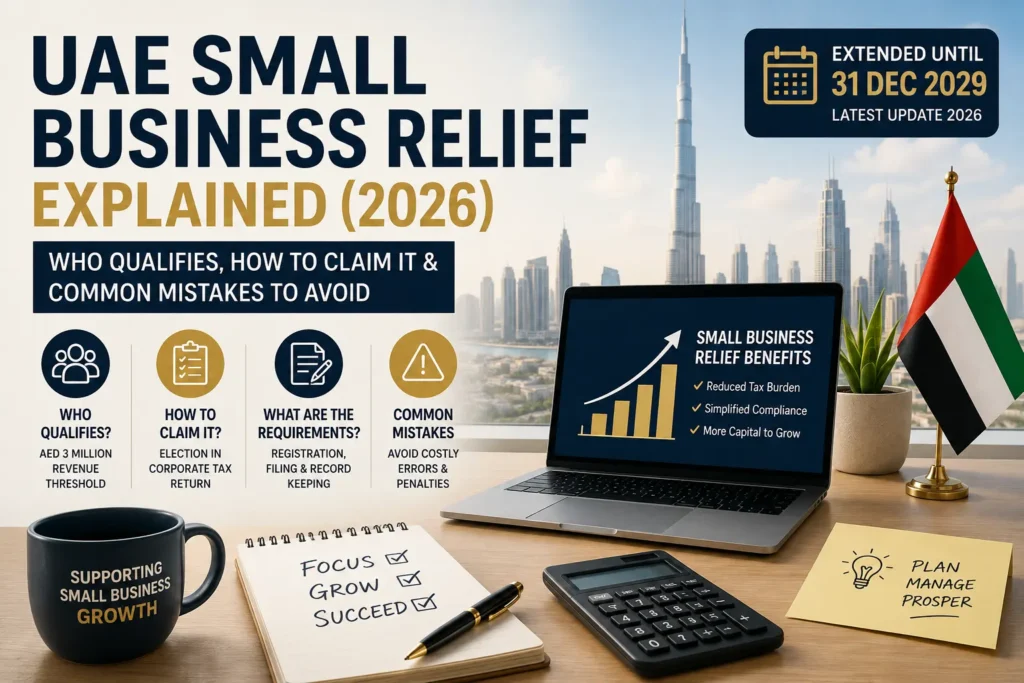
UAE Small Business Relief Explained: Everything Business Owners Need to Know
When the UAE introduced Corporate Tax, many entrepreneurs assumed every profitable business would immediately start paying 9% tax.
Fortunately, that’s not always the case.
To support startups and SMEs, the UAE introduced Small Business Relief (SBR) under Article 21 of the Corporate Tax Law. If your business qualifies, you are treated as having no taxable income for the relevant tax period, meaning no Corporate Tax is payable for that period.
However, this relief is widely misunderstood.
Many businesses wrongly believe that:
- They don’t need Corporate Tax registration.
- They don’t need to file a Corporate Tax Return.
- Profit below AED 3 million qualifies.
- The relief is automatic.
All of these assumptions are incorrect.
In this guide, we explain exactly who qualifies, how the relief works, and the mistakes that could cost your business.
What is Small Business Relief?
Small Business Relief is a Corporate Tax concession available to eligible UAE Resident Persons.
Instead of calculating taxable income and paying Corporate Tax, an eligible business may elect to be treated as having no taxable income for that tax period.
In simple terms:
If you qualify and elect the relief correctly, your Corporate Tax liability for that period is nil.
The purpose is to reduce the compliance burden for smaller businesses while allowing them to grow during the early years.
Who Can Claim Small Business Relief?
You may qualify if:
- You are a Resident Person for UAE Corporate Tax purposes.
- Your revenue in the current tax period and every previous relevant tax period does not exceed AED 3 million.
- You elect Small Business Relief in your Corporate Tax Return.
Notice the word revenue.
This is one of the biggest misconceptions.
The threshold is not based on profit.
Revenue vs Profit – Why It Matters
Many business owners ask:
“My profit is only AED 150,000. Can I claim Small Business Relief?”
The answer depends on your revenue, not your profit.
Example
ABC Consultancy has:
- Revenue: AED 2.8 million
- Expenses: AED 2.2 million
- Profit: AED 600,000
Since revenue is below AED 3 million and the other conditions are met, the company may elect Small Business Relief.
Now consider another company:
- Revenue: AED 4 million
- Profit: AED 100,000
Although profit is low, revenue exceeds AED 3 million.
The business is not eligible.
What Happens If Revenue Exceeds AED 3 Million?
This is another common misunderstanding.
Once your revenue exceeds AED 3 million in any relevant tax period, Small Business Relief is no longer available for subsequent eligible periods.
Example
2024 Revenue: AED 2.2 million
2025 Revenue: AED 2.7 million
2026 Revenue: AED 3.4 million
Because revenue exceeded AED 3 million in 2026, the business cannot continue claiming Small Business Relief after that point under the applicable rules.
Does Small Business Relief Mean You Don't Need to Register?
No.
This is probably the most expensive misconception.
Eligible businesses must still comply with Corporate Tax registration requirements where applicable.
Small Business Relief only affects how taxable income is calculated.
It does not remove registration obligations.
Do You Still Need to File a Corporate Tax Return?
Yes.
The Federal Tax Authority has specifically clarified that businesses claiming Small Business Relief must submit a simplified Corporate Tax Return within the prescribed deadline and elect the relief.
Skipping your return because “I don’t have tax to pay” could expose your business to penalties.
Is the Relief Automatic?
No.
You must actively elect Small Business Relief for the relevant tax period when filing your Corporate Tax Return.
If you simply assume it applies without making the election, you may not receive the intended relief.
Who Cannot Claim Small Business Relief?
The relief is not available to:
- Qualifying Free Zone Persons claiming the Qualifying Free Zone regime.
- Members of multinational enterprise (MNE) groups with consolidated global revenue above AED 3.15 billion.
Do You Still Need Proper Accounting Records?
Absolutely.
Although the tax burden is reduced, businesses must still maintain books and records to demonstrate eligibility.
The FTA can review your revenue and supporting documentation to verify that the conditions were met.
Latest Update: UAE Extends Small Business Relief Until 2029
In a significant boost for startups and small businesses, the UAE Ministry of Finance has extended the availability of Small Business Relief (SBR) until 31 December 2029 through Ministerial Decision No. 131 of 2026, replacing the previous sunset date of 31 December 2026. This extension provides eligible businesses with an additional three years of Corporate Tax relief, allowing them to focus on growth while reducing their tax burden. Importantly, the extension does not change the eligibility criteria. Businesses must still satisfy the existing conditions, including the AED 3 million annual revenue threshold, elect the relief in their Corporate Tax Return, and comply with all applicable filing and record-keeping requirements. While the relief period has been extended, businesses should not assume they are automatically eligible and should carefully assess their position each tax period before making the election.
Final Thoughts
Small Business Relief is one of the most valuable features of the UAE Corporate Tax regime for startups and SMEs. It can significantly reduce the tax and compliance burden during the early stages of growth—but only if it is applied correctly.
Remember these four key points:
- The AED 3 million threshold is based on revenue, not profit.
- Eligible businesses must still register where required and file a Corporate Tax Return.
- The relief is not automatic; it must be elected.
- Maintain accurate accounting records to support your eligibility.
If you’re unsure whether your business qualifies or need assistance with Corporate Tax registration, return filing, or assessing your eligibility for Small Business Relief, obtaining professional advice can help ensure compliance and avoid costly mistakes.