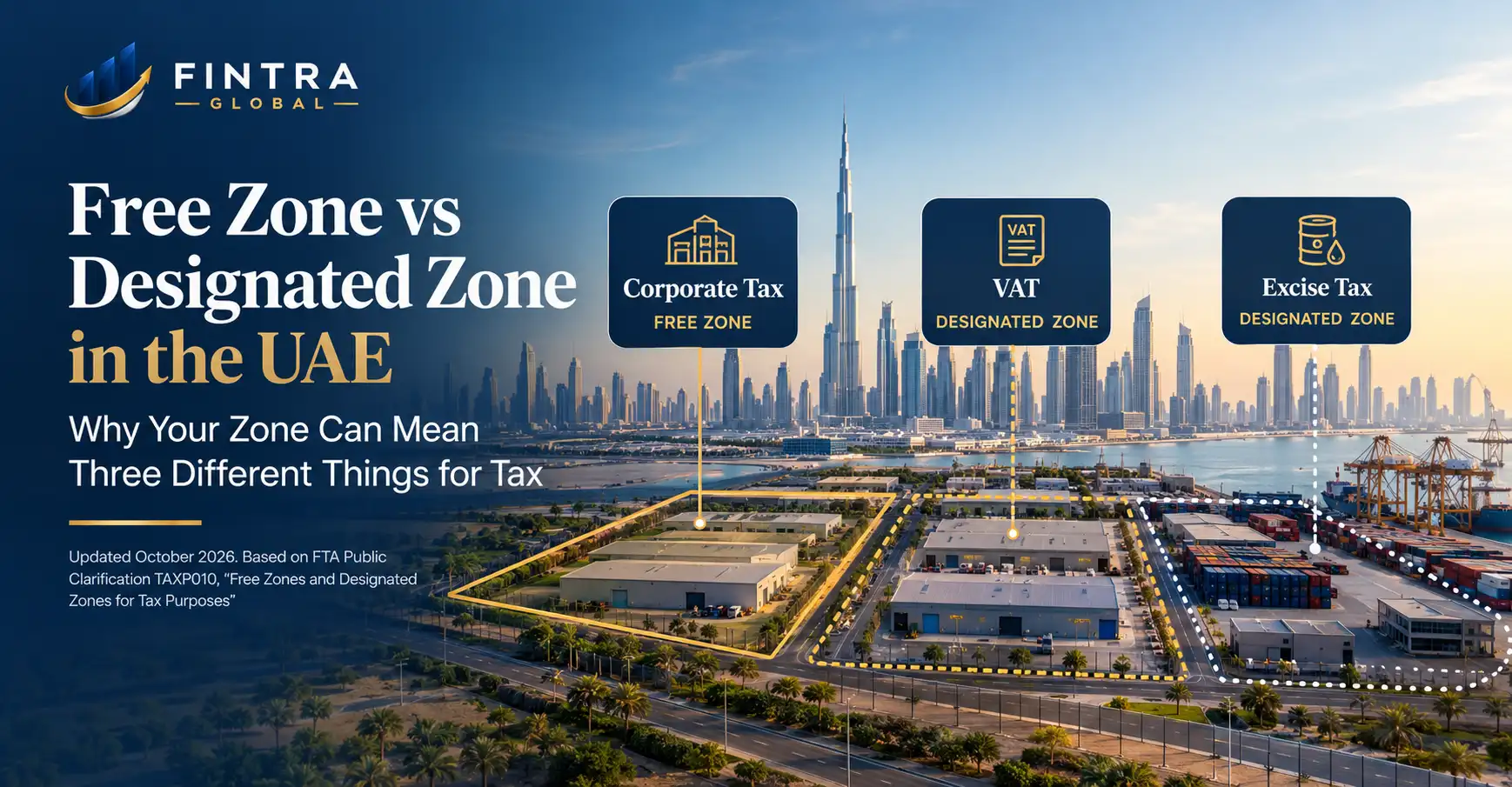
Most UAE businesses answer the question “are we in a free zone?” by looking at their trade license. For tax purposes, that answer is incomplete.
The Federal Tax Authority has now said so directly. Its Public Clarification TAXP010 confirms that the UAE’s three tax laws — Corporate Tax, VAT and Excise Tax — each define “free zone” and “designated zone” differently, and that a business must work out where it stands under each law separately.
The same address can be a free zone for Corporate Tax, outside the designated zone for VAT, and irrelevant for Excise. Getting it wrong affects your 0% Corporate Tax rate, how you charge VAT on goods, and whether excise goods move under suspension.
The short answer
A free zone licence does not, on its own, tell you your tax position. There are four separate tests across three laws, and a VAT designated zone is not automatically a designated zone for Corporate Tax.
The four zones the FTA distinguishes
TAXP010 identifies four categories. Each has its own definition, its own legal source and its own way of checking.
| Zone | What it is | How to confirm |
|---|---|---|
| Corporate Tax Free Zone | A geographic area specified in a Cabinet Decision issued for Corporate Tax purposes | Your free zone authority |
| Corporate Tax Designated Zone | A zone on the VAT List of Designated Zones and included as a Free Zone under the Corporate Tax Law | Your free zone authority |
| VAT Designated Zone | A fenced zone listed in Cabinet Decision No. 59 of 2017 that meets the Article 51(1) conditions | The FTA’s published list, then your free zone authority for the specific area |
| Excise Tax Designated Zone | A fenced free zone, or an FTA-approved area, supervised by a registered Warehouse Keeper | Your free zone authority or the Warehouse Keeper |
Corporate Tax: free zone, designated zone, and why the difference matters
For Corporate Tax, a Free Zone is a designated and defined geographic area specified by Cabinet Decision. Being incorporated, established or registered there makes you a Free Zone Person — and opens the door to the Qualifying Free Zone Person regime, with 0% Corporate Tax on Qualifying Income if you meet the conditions under Article 18, Cabinet Decision No. 100 of 2023 and Ministerial Decision No. 229 of 2025.
A Corporate Tax Designated Zone is narrower. It must satisfy two tests at once: it must appear on the VAT List of Designated Zones, and it must also be a Free Zone under the Corporate Tax Law.
The point most businesses miss
A VAT designated zone is not automatically a Corporate Tax designated zone. TAXP010 states this explicitly. If your zone appears on the VAT list but is not a Corporate Tax Free Zone, it does not qualify for Corporate Tax purposes.
Why it matters: the distribution activity
Most free zone businesses never need the designated zone distinction. Distributors do.
Ministerial Decision No. 229 of 2025 lists “distribution of goods or materials in or from a Designated Zone” as a Qualifying Activity. Every Qualifying Free Zone Person must be registered in and operate from a free zone — but to treat distribution income as qualifying, the distribution itself must be carried out in or from a Corporate Tax Designated Zone.
The activity covers buying and selling tangible goods, including importing, storing, handling, transporting and exporting them. Two further conditions apply:
- Goods entering the UAE must be imported through the designated zone.
- Goods must be supplied to a customer who resells, processes or alters them for sale or resale — or to a public benefit entity.
In practice, a free zone trader selling goods to mainland end users, or operating from a free zone that is not a Corporate Tax Designated Zone, cannot rely on the distribution activity for those sales. FTA-prescribed additional procedures also apply to distributors under Ministerial Decision No. 84 of 2025.
The cost of getting it wrong is five years. A Qualifying Free Zone Person that fails any condition at any point in a tax period ceases to qualify from the start of that period and for the four following periods. One misread of your zone status can push the whole business to 9% for five tax periods.
VAT: when a designated zone counts as “outside the UAE”
For VAT, a Designated Zone is a fenced area listed in Cabinet Decision No. 59 of 2017 and its amendments. Under Article 51(1) of the VAT Executive Regulation, it is treated as outside the State — but only if three conditions are met:
- It is a specific fenced geographic area with security measures and customs controls over people and goods entering and leaving.
- It has internal procedures for keeping, storing and processing goods.
- Its operator complies with procedures set by the FTA.
Here is the detail TAXP010 adds: being on the published list is not the end of the check. A business must confirm with its free zone authority that the Article 51(1) conditions are met by the specific area of the zone where the company is based.
Worth checking
Several free zones have expanded over the years, and not every part of a large zone is necessarily fenced and customs-controlled. A company in a newer section, a business park or an office tower inside a listed zone should confirm its own area rather than assume the whole zone qualifies. The designated zone rules also apply to goods — services supplied in a designated zone generally follow the normal UAE VAT rules.
Excise Tax: the Warehouse Keeper test
For Excise Tax — on tobacco, energy drinks, carbonated and sweetened drinks, and electronic smoking devices — a Designated Zone is either:
- A fenced free zone with security controls over people and excise goods, supervised by a customs department, with a Warehouse Keeper appointed; or
- Any other geographic area approved by the FTA, with the same security controls and a Warehouse Keeper, where the Warehouse Keeper has applied to register it.
The Warehouse Keeper is the deciding factor. Without one, an area is not an Excise Tax Designated Zone, however it is described on a licence. Businesses should confirm with their free zone authority or the Warehouse Keeper that the FTA has approved the area.
How the three tests compare
| Corporate Tax | VAT | Excise Tax | |
|---|---|---|---|
| Legal basis | Cabinet Decision on Free Zones; Cabinet Decision 100/2023 | Cabinet Decision 59/2017; VAT Exec. Reg. Art. 51(1) | Excise Tax Law Art. 13; Exec. Reg. Art. 15(2) |
| Must be fenced? | Not for Free Zone; yes for Designated Zone (via VAT list) | Yes | Yes |
| Key gatekeeper | Cabinet Decision | FTA list + zone operator | Warehouse Keeper |
| What it affects | 0% rate; distribution as a Qualifying Activity | Whether goods supplies are outside the UAE | Suspension of excise on goods |
| Confirm with | Free zone authority | FTA list, then free zone authority | Free zone authority or Warehouse Keeper |
Who should act on this
- Free zone distributors and traders claiming the distribution activity — confirm the Corporate Tax Designated Zone status, the import route, and who your customers are.
- Companies in large or expanded free zones — confirm your specific area meets Article 51(1) for VAT.
- Groups with entities in several zones — each entity’s position can differ under each law.
- Businesses handling excise goods — confirm a Warehouse Keeper supervises your area.
- Anyone preparing a Corporate Tax return on a 0% position — your zone status underpins the claim.
What to do now
- Write to your free zone authority and ask, in writing, whether your registered address is a Free Zone and a Designated Zone for Corporate Tax, and whether your specific area meets Article 51(1) for VAT.
- Check the FTA’s List of Designated Zones for VAT, then confirm your area with the zone operator.
- Map revenue by activity and customer. Separate distribution income from other qualifying income, and identify sales to mainland end users.
- Trace the import route for goods entering the UAE — distribution requires import through the designated zone.
- Keep the confirmations on file with your Corporate Tax workpapers and audited financial statements.
- Review it annually, and whenever you move premises, open a new warehouse or change how goods flow.
A written confirmation from your free zone authority costs nothing and is the single most useful document you can hold if the FTA ever questions your 0% position. It also tends to surface problems early — usually a warehouse or office in a part of the zone nobody had checked.
Frequently asked questions
Is every UAE free zone a designated zone?
No. A designated zone is a narrower category. For VAT it must be on the Cabinet list and meet the fencing and customs conditions; for Corporate Tax it must be both on the VAT list and a Corporate Tax Free Zone.
Is a VAT designated zone automatically a designated zone for Corporate Tax?
No. TAXP010 states this explicitly. The zone must also be included as a Free Zone under the Corporate Tax Law.
How do I confirm my company’s zone status?
For Corporate Tax, confirm with your free zone authority. For VAT, check the FTA’s List of Designated Zones and confirm your specific area with the zone authority. For Excise, confirm with the free zone authority or the Warehouse Keeper.
Can a free zone distributor still get 0% Corporate Tax?
Yes, on Qualifying Income — but distribution counts as a Qualifying Activity only if carried out in or from a Corporate Tax Designated Zone, with goods imported through that zone and supplied to customers who resell or process them, or to a public benefit entity.
What happens if a Qualifying Free Zone Person fails a condition?
It loses QFZP status from the beginning of that tax period and for the following four tax periods, and is taxed at the standard rates for that time.
Does TAXP010 change the law?
No. A Public Clarification states the FTA’s position and does not amend legislation. It applies from the date the underlying legislation took effect.
How Fintra Global can help
Zone status sits at the meeting point of Corporate Tax, VAT and company structure — which is why it is so often missed. We review it as one question rather than three.
For free zone businesses we obtain and file the zone confirmations, test your activities and customers against the Qualifying Income rules, model the exposure if the distribution activity does not apply, and align your audited financial statements and Corporate Tax return with the position. For new businesses, we factor tax status into free zone selection before you sign a lease, rather than after.
Related reading: FTA Decision 13 of 2026 and VAT input tax verification · UAE e-invoicing deadlines for free zone companies · withholding tax and cross-border payments.
Free zone tax status review
Not sure whether your zone counts for Corporate Tax, VAT or Excise? Tell us your free zone, your address and what you sell. We’ll tell you where you stand under each law. Fixed timeline, transparent pricing, CA-led.
This article is general guidance based on FTA Public Clarification TAXP010 and the legislation it references, current as at October 2026. It is not tax advice. Zone status depends on your specific address and activities; please confirm your position before acting.